


When the Past Feels Present: How to Pause, Check the Story, and Choose Your Response
- Jaime Hernandez
- 11 minutes ago
- 9 min read

When the Past Feels Present: How to Pause, Check the Story, and Choose Your Response
A Practical CBT- and DBT-Informed Guide to Relationship Triggers, Stress, Trust, and Healing
Have you ever walked away from a conversation and wondered why it affected you so deeply?
Maybe a trainer corrected your form, but the correction felt like criticism. A healthcare provider offered instructions, but your body heard control. A partner became quiet, and your mind immediately prepared for rejection. Someone asked what you needed, yet instead of answering honestly, you automatically said, “I’m fine.”
The current moment may be real, but it may not be the only thing influencing your reaction.
Sometimes the nervous system responds not only to what is happening now, but also to what the present moment resembles. A facial expression, tone of voice, boundary, correction, silence, or request may activate expectations shaped by an earlier relationship.
Psychodynamic therapy uses the term transference to describe the process of redirecting feelings, expectations, or relationship patterns associated with important people from the past onto someone in the present. Transference can be explored in psychotherapy, but research has not established that interpreting it produces the same benefits for every person or situation. A 2024 systematic review found promising results in some studies while emphasizing substantial differences in methods, participants, treatments, and outcomes.
For everyday life, we do not need to diagnose every reaction or analyze every childhood experience. We can begin with something more practical:
Notice the reaction, calm the intensity, examine the story, and choose a response that fits the present.
That is where skills informed by Cognitive Behavioral Therapy and Dialectical Behavior Therapy can help.
Is This CBT, DBT, or Psychodynamic Therapy?
The answer is a combination, with each approach contributing something different.
Psychodynamic therapy provides the lens. It asks whether an old relationship pattern may be entering a current interaction.
Cognitive Behavioral Therapy provides the investigation. CBT helps people identify automatic thoughts, examine the evidence supporting those thoughts, and experiment with more balanced interpretations and behaviors. Research on CBT techniques suggests that both structured thought records and behavioral experiments can help change beliefs, anxiety, behavior, and symptoms.
Dialectical Behavior Therapy provides regulation and communication skills. DBT commonly teaches mindfulness, distress tolerance, emotion regulation, and interpersonal effectiveness. Research examining DBT skills modules found that each of these areas was associated with improvements in emotion regulation among a diagnostically diverse group of participants.
In plain language:
Psychodynamic insight asks where the pattern came from. CBT checks whether the story fits the evidence. DBT helps you stay grounded enough to respond effectively.
This article is not a replacement for any of these therapies. It is an educational way to borrow several practical principles for daily self-awareness.
Your Feelings Are Real—But They May Not Tell the Whole Story
One of the most helpful DBT-informed ideas is that two things can be true at the same time.
Your emotional reaction can be understandable based on your experiences.
And your first interpretation of the current situation may be incomplete.
You may feel rejected without actually being rejected. You may feel controlled while someone is simply offering structure. You may feel criticized when a person is trying to clarify a misunderstanding.
The opposite can also be true. A strong emotional reaction does not automatically mean you are misreading the situation. Someone may actually be dismissing your concerns, applying inappropriate pressure, crossing a boundary, or behaving unsafely.
The goal is not to convince yourself that everything is fine.
The goal is to slow down long enough to tell the difference between a familiar emotional alarm and a present-day problem requiring action.
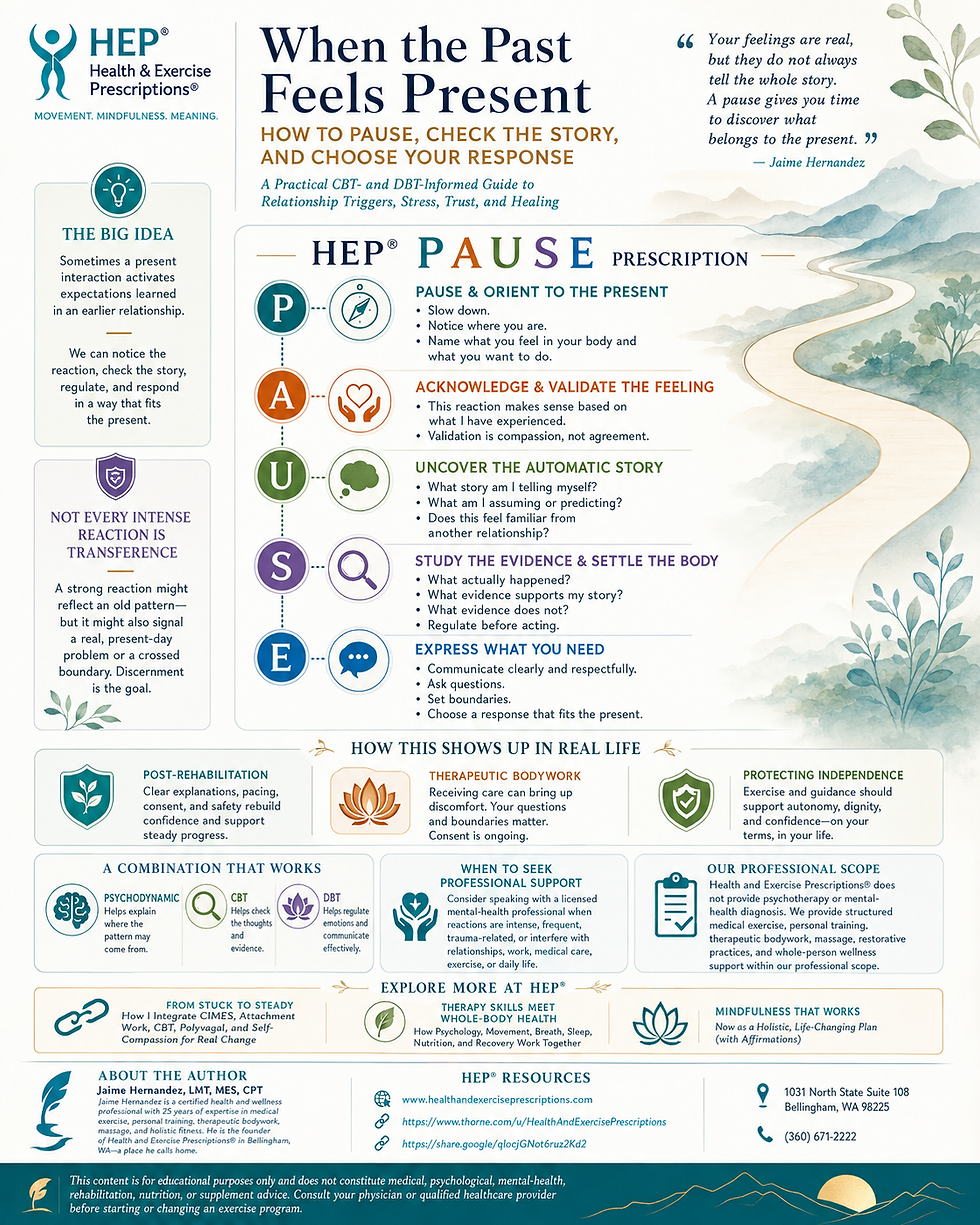
The HEP® PAUSE Prescription
When a reaction feels unusually intense, use this five-step process before making a major decision, sending a message, ending a relationship, or agreeing to something you do not want.
P: Pause and Orient to the Present
Begin with the body.
Place both feet on the floor. Look around the room and identify where you are. Notice the support beneath you. Allow your exhale to become slightly slower without forcing a deep breath.
Then name what is happening:
“I notice that my chest feels tight.”
“I notice that I want to leave.”
“I notice that I want to agree even though I am uncomfortable.”
“I notice that I am preparing to defend myself.”
This is a DBT-informed mindfulness step. You are observing the reaction instead of immediately becoming the reaction.
A: Acknowledge and Validate the Feeling
Try saying:
“This reaction makes sense based on what I have experienced.”
Validation does not mean every conclusion is accurate. It means the emotion deserves attention rather than shame.
You do not have to tell yourself that you are being ridiculous, dramatic, weak, or too sensitive. Self-criticism usually adds another layer of tension without helping you understand what is happening.
A more useful statement is:
“Something about this feels familiar. I am going to slow down before deciding what it means.”
U: Uncover the Automatic Story
This is where CBT-informed awareness becomes useful.
Ask yourself:
What am I assuming this person thinks about me?
What am I predicting will happen next?
What does this situation seem to mean about my value, safety, competence, or independence?
Does this feeling remind me of another person or relationship?
The automatic story may sound like:
“They think I am weak.”
“My needs are inconvenient.”
“I have to keep everyone happy.”
“If I disagree, they will leave.”
“I am going to lose control.”
“I will be hurt again.”
An automatic thought is not the same as a fact. It is the mind’s rapid interpretation of a situation, often shaped by previous learning and experience.
S: Study the Evidence and Settle the Body
Now separate what you know from what you fear.
What did the person actually say?
What observable behavior occurred?
What evidence supports my interpretation?
What evidence does not support it?
Is there another reasonable explanation?
Has this person shown a pattern of disrespect, or was this one confusing interaction?
If emotional intensity remains high, continue regulating before trying to solve the problem. Take a short walk, relax your jaw, place a hand over your chest, drink water, write down the facts, or speak with a trusted person.
Regulation is not avoidance. It helps create the conditions for a clearer decision.
E: Express What You Need
A healthier response does not always mean staying quiet or being agreeable.
It may mean asking:
“Could you explain what you meant?”
“I need more time before I decide.”
“Please tell me what you are going to do before touching me.”
“That pace feels too fast for me.”
“I would like to understand the purpose of this exercise.”
“When the conversation suddenly stops, I notice that I assume something is wrong. Can we clarify what is happening?”
Direct communication gives the other person an opportunity to respond to the present concern. Their response also gives you new information.
A respectful person may clarify, slow down, apologize, or adjust.
An unsafe or dismissive person may continue ignoring your boundary.
Both responses provide evidence.
How This Appears in Health, Exercise, and Recovery
After Rehabilitation
Someone who has previously been hurt, dismissed, or progressed too aggressively may enter a new exercise program expecting the same experience. Even an appropriate correction may activate fear.
The answer is not to push through that fear without discussion.
At Health and Exercise Prescriptions®, medical exercise is built around explanation, structure, symptom monitoring, appropriate pacing, and client participation. The goal is to provide repeated experiences in which movement becomes understandable and manageable.
Each successful session can offer the body new evidence:
“I can challenge myself without losing control of the process.”
During Massage or Therapeutic Bodywork
Some people have difficulty receiving care. They may apologize for needing less pressure, hesitate to ask questions, or remain guarded throughout the session.
Consent should not be a one-time form. It is an ongoing conversation.
A client should be able to request changes, pause a session, ask what is happening, or decline a technique. Therapeutic bodywork should support dignity and communication rather than recreating an experience of powerlessness.
While Protecting Independence
An older adult may hear recommendations for balance training or exercise modification as evidence that independence is disappearing.
A respectful health prescription connects the exercise to what the person values: staying in their own home, walking outside, carrying groceries, maintaining confidence, or playing with grandchildren.
The client remains an active partner rather than becoming a problem someone else is trying to manage.
Awareness Is Not About Blaming the Past
The purpose of identifying old patterns is not to blame parents, former partners, previous providers, or yourself for every difficulty.
The purpose is to recognize when the past may be influencing the present so you can respond with greater choice.
Sometimes you will discover that the current person is trustworthy and the old alarm can gradually soften.
Sometimes you will discover that the current relationship is repeating an unhealthy pattern and a stronger boundary is needed.
Sometimes you will remain uncertain and need help from a licensed mental-health professional.
All three outcomes are valid.
When Professional Support Is Important
Consider speaking with a licensed therapist when reactions are intense, frequent, difficult to understand, connected to trauma, or repeatedly interfere with relationships, work, medical care, exercise, or daily life.
A licensed mental-health professional can provide individualized assessment and treatment using CBT, DBT, psychodynamic therapy, schema therapy, trauma-focused approaches, or another appropriate method.
Health and Exercise Prescriptions® does not provide psychotherapy or diagnose transference, attachment disorders, trauma, or mental-health conditions.
My role is to provide structured medical exercise, personal training, therapeutic bodywork, massage, restorative practices, breathwork, and whole-person wellness support within professional scope.
Psychological treatment and physical wellness support can complement one another without becoming the same service.
The Past May Enter the Room, but It Does Not Have to Run the Conversation
Your body learned ways to protect you. Some of those patterns may still be helpful. Others may be responding to a life you no longer live.
The goal is not to eliminate every uncomfortable emotion. It is to become less controlled by the first interpretation that appears.
Pause.
Acknowledge what you feel.
Uncover the story.
Study the evidence.
Express what you need.
The past may influence the moment, but awareness gives you the opportunity to choose what happens next.
Build a Health Plan That Respects Your History
At Health and Exercise Prescriptions®, health is not approached as a demand to push harder. It is approached as a personalized prescription built around safety, structure, movement, recovery, communication, and sustainable progress.
Supplements do not treat transference, trauma, attachment wounds, or relationship difficulties. When appropriate, professional-grade supplements may support broader nutritional, sleep, or stress-management goals under qualified healthcare guidance.
Related Health and Exercise Prescriptions® Articles
Research and Further Reading
Yılmaz M, et al. “Transference Interpretation and Psychotherapy Outcome: A Systematic Review of a No-Consensus Relationship.” Research in Psychotherapy, 2024.
Marazzi F, et al. “Transference Assessment in Psychotherapy: A Systematic Review.” 2025.
McManus F, et al. “Examining the Effects of Thought Records and Behavioral Experiments in Instigating Belief Change.” Journal of Behavior Therapy and Experimental Psychiatry, 2012.
Heath N, et al. “Group-Based DBT Skills Training Modules Are Linked to Independent and Additive Improvements in Emotion Regulation.” 2021.
Eubanks CF, et al. “Alliance Rupture Repair: A Meta-Analysis.” Psychotherapy, 2018.
Legal Disclaimer
This content is for educational purposes only and does not constitute medical, psychological, mental-health, rehabilitation, nutrition, or supplement advice. It is not intended to diagnose, treat, cure, or prevent any disease, injury, mental-health condition, trauma response, attachment concern, or relationship difficulty.
Consult your physician or qualified healthcare provider before starting or changing an exercise program—especially if you have pain, injuries, cardiovascular, metabolic, neurological, psychological, or other medical conditions. Stop any activity that causes sharp pain, dizziness, chest discomfort, faintness, unusual shortness of breath, neurological symptoms, or anything that feels unsafe.
This article does not provide psychotherapy, CBT, DBT, trauma treatment, mental-health diagnosis, or individualized psychological interpretation. Recurring emotional triggers, trauma symptoms, transference, attachment concerns, or significant distress should be explored with an appropriately licensed mental-health professional.
Consult a qualified healthcare professional before beginning or changing a supplement routine, especially if you take medication, are pregnant or nursing, have a medical condition, or are preparing for surgery.
Author Bio
Jaime Hernandez is a certified health and wellness professional with 25 years of expertise in medical exercise, personal training, therapeutic bodywork, massage, and holistic fitness. He is the founder and Executive Coach of Health and Exercise Prescriptions® in Bellingham, WA, where he develops personalized health and wellness plans designed to help individuals improve strength, mobility, and overall well-being across all stages of life.
Jaime holds certifications as a Medical Exercise Specialist, Licensed Massage Therapist # MA60804408, and trainer in Yoga, Pilates, and Craniosacral Therapy, combining multiple modalities to support post-rehabilitation recovery, preventive health, and functional movement optimization. His approach blends science-based exercise prescription with therapeutic practice to help clients prevent disease, manage chronic conditions, and achieve their health goals.
Health and Exercise Prescriptions®
Thank you for your time and energy...Be well.


Comments