


How Abdominal Movement May Help the Brain Clear Waste

How Abdominal Movement May Help the Brain Clear Waste
The Hidden “Core Pump” That Makes Everyday Movement Brain Care
There is a quiet intelligence inside the body that we often overlook.
We think of exercise as something we do to build muscle, burn calories, improve balance, lose weight, or recover from injury. And yes, movement can do all of those things. But new neuroscience is reminding us of something deeper:
Movement is not just fitness. Movement is maintenance.
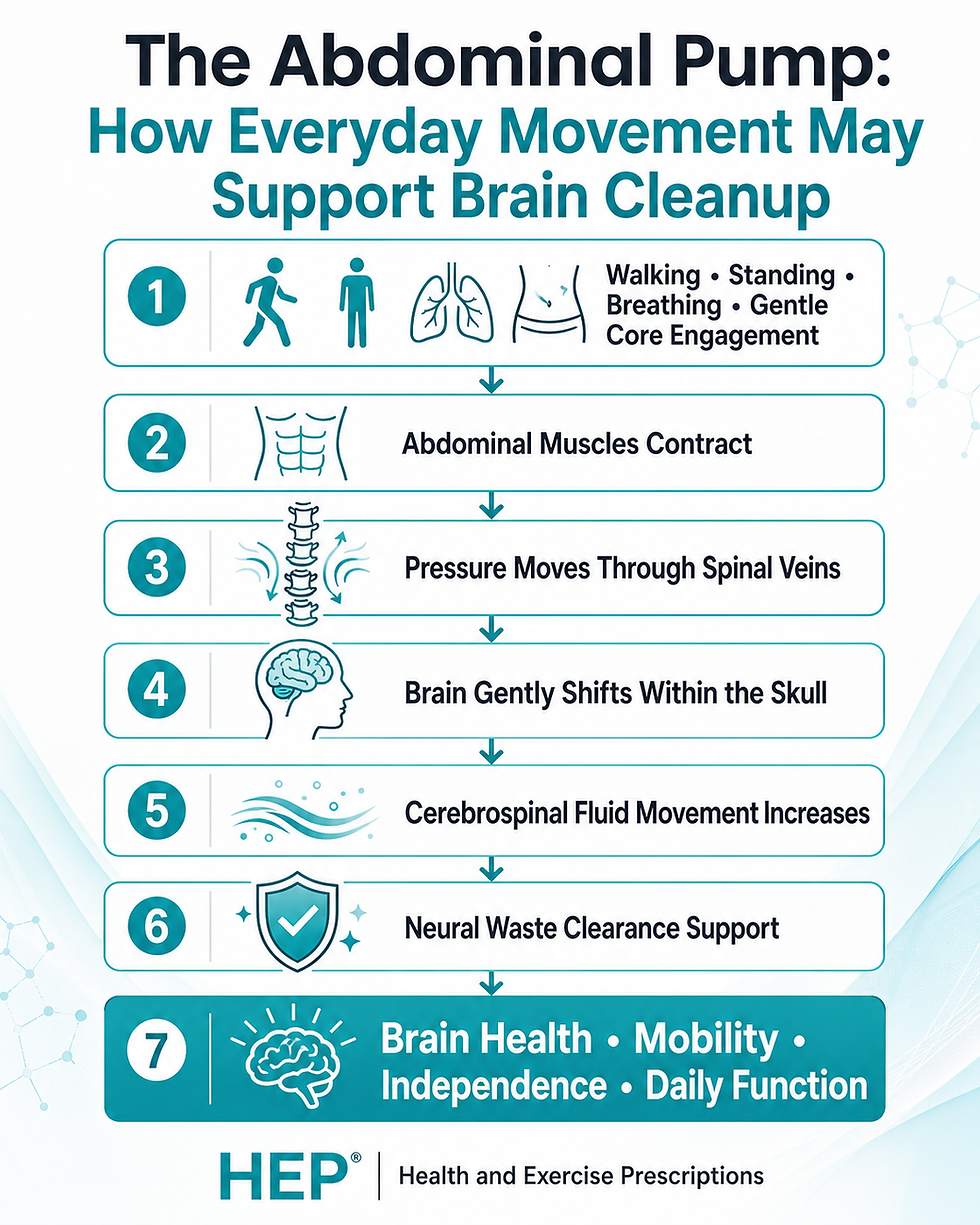
A recent Penn State study reported in Nature Neuroscience suggests that abdominal muscle contractions may help create a hydraulic-like pump between the body, spine, and brain. In simple terms, when the abdominal muscles contract—even during something as ordinary as taking a step—they may compress blood vessels connected to the spinal cavity, creating subtle pressure changes that help move cerebrospinal fluid around the brain. That fluid movement may support the brain’s natural waste-clearing systems.
That is a powerful idea.
Not because it means you need to do more sit-ups. Not because it means exercise is a magic cure. And not because this early research answers every question about brain health.
It matters because it gives us another reason to respect the basics: walking, breathing, standing, gentle core activation, posture, mobility, and safe daily movement.
At Health and Exercise Prescriptions®, this is the kind of science that reinforces what I see every day: the body is not a collection of separate parts. The core, spine, circulation, nervous system, brain, breath, and movement patterns are all in conversation.
When one system moves better, the whole person may function better.
The Brain Has a Cleanup System
Your brain is metabolically expensive. It works all day, every day. It processes information, regulates emotions, coordinates movement, manages hormones, responds to stress, and helps you make decisions.
Like any hardworking system, it creates waste.
Researchers have been studying how cerebrospinal fluid, or CSF, helps move through and around the brain to support waste clearance. This system is often discussed through the lens of the “glymphatic system,” a proposed brain-wide clearance pathway that appears especially active during sleep. AP reported that researchers have observed waste-clearing channels in living human brains, adding support to earlier animal research showing that CSF can move through channels around blood vessels and help clear cellular waste.
Sleep still matters deeply. Hydration matters. Blood flow matters. Cardiovascular health matters. Stress recovery matters.
But now, this new research adds another fascinating layer:
Body movement may help the brain mechanically move fluid, too.
The “Abdominal Pump” Explained
The Penn State researchers found that abdominal contractions may activate a hydraulic-like connection between the abdomen, spine, and brain. When the abdominal muscles contract, they can put pressure on the vertebral venous plexus, a network of veins connected to the spinal cavity. This pressure may gently influence the position of the brain inside the skull and help drive fluid motion around brain tissue.
The researchers described the brain almost like a sponge.
If you want to clean a sponge, you do not just let water sit around it. You gently squeeze and release it. That squeeze-and-release action helps fluid move through.
This study suggests that small body-driven motions may help create a similar mechanical effect in the brain. The movement is subtle, not violent. It is not something you would feel happening. But the concept is profound: your everyday movement may help create the physical conditions for brain fluid circulation.
The study was done in mice and computer simulations, so we need to be careful. This does not prove that abdominal contractions prevent dementia in humans. It does not mean core exercises treat neurological disease. It does not replace medical care.
But it does support a bigger principle:
The brain benefits from a body that moves.
This Is Not About Six-Pack Abs
Let me be very clear: this is not a blog post about doing extreme core workouts.
For many people—especially post-rehab clients, older adults, people with back pain, or anyone recovering from injury—the wrong abdominal exercise can create more strain than benefit.
This is not about crunches, boot camps, or pushing through pain.
This is about intelligent core engagement.
Your abdominal wall participates in almost everything you do: standing from a chair, walking, reaching, breathing, rolling over in bed, carrying groceries, climbing stairs, and stabilizing your spine when you shift directions.
A healthy core is not just about appearance. It is about pressure regulation, spinal support, balance, breath coordination, and safe movement.
Now we may be learning that these same abdominal contractions may also play a role in supporting fluid movement around the brain.
That changes the conversation.
Your core is not just a “muscle group.”It is part of your body’s internal support system.
Why Walking May Be Brain Care
Walking is one of the most underrated health tools we have.
It is accessible, scalable, rhythmic, and neurologically rich. Walking involves alternating movement, balance, visual input, breath rhythm, cardiovascular circulation, spinal motion, and gentle core engagement.
For the post-rehab client, walking can rebuild trust.
For the holistic wellness seeker, walking can regulate stress.
For the older adult, walking can preserve independence.
And now, this abdominal-pump research gives us another possible reason walking matters: each step may create subtle abdominal and spinal pressure changes that help influence fluid movement around the central nervous system.
That does not mean walking is the only answer. But it does mean walking deserves more respect.
A 10-minute walk is not “nothing.”A slow walk after sitting all day is not “too easy.”A gentle daily rhythm is not a waste of time.
For many people, the safest and most effective place to begin is not intensity.
It is consistency.
What This Means for Post-Rehab and Older Adult Wellness
If you have been injured, deconditioned, sedentary, or afraid to move, your body may not need punishment.
It may need structure.
This is where medical exercise becomes so important. The goal is not to throw random exercises at the body. The goal is to choose the right movement, at the right dose, for the right person, at the right time.
For a post-rehab client, that may mean rebuilding strength without provoking symptoms.
For someone with balance concerns, it may mean practicing safe transitions: sit-to-stand, step-ups, gait training, posture, and controlled weight shifts.
For an older adult, it may mean protecting independence: getting out of a chair, walking confidently, carrying groceries, staying active with family, and reducing fall risk.
For someone overwhelmed by stress, it may mean using breath, gentle mobility, and restorative movement to help the nervous system feel safe again.
This new research does not change the fundamentals. It strengthens them.
The small movements matter.
The chair rises. The short walks. The breathing drills. The mobility work. The gentle core activation. The posture resets. The balance practice.
These are not just “beginner exercises.”
They are biological inputs.
A Safe HEP® Movement Prescription
Here is a simple, practical starting point for many people:
1. Walk daily at a comfortable pace. Start with 5–10 minutes if needed. Build gradually. The goal is not exhaustion. The goal is rhythm.
2. Practice gentle belly breathing. Place one hand on your abdomen. Breathe in slowly through the nose and allow the abdomen and ribs to expand. Exhale gently and feel the abdominal wall return.
3. Add safe sit-to-stand practice. Use a sturdy chair. Stand up with control. Sit down slowly. This builds legs, balance, and functional core engagement.
4. Use posture breaks. If you sit for long periods, stand up every 30–60 minutes. Reach, breathe, walk, or gently rotate.
5. Strength train with guidance. Core work should match your spine, history, pain level, and goals. For some people, planks are appropriate. For others, dead bugs, heel taps, wall presses, or breathing-based core activation are safer.
The goal is not to force the body.
The goal is to restore intelligent function.
The Bigger Message: Your Body Was Designed to Circulate, Shift, Pump, and Recover
Modern life makes stillness easy.
We sit in cars. We sit at desks. We sit on couches. We stare at screens. We compress the breath. We stiffen the spine. We lose the small movements that used to be built into everyday living.
Then we wonder why the body feels heavy, stiff, anxious, tired, or disconnected.
The answer is not always more intensity.
Sometimes the answer is more rhythm.
More walking.More breathing.More posture changes.More gentle strength.More recovery.More respect for the body’s design.
This abdominal-pump research gives us a beautiful reminder: movement may be helping us in ways we are only beginning to understand.
Your body is not separate from your brain.
Your core is not separate from your spine.
Your breath is not separate from your nervous system.
Your daily movement is not separate from your long-term health.
At Health and Exercise Prescriptions®, we use safe, structured medical exercise, bodywork, mobility training, and wellness planning to help people move better, recover smarter, and build confidence in their body again.
Because movement is not just something you do.
Movement is how the body keeps communicating, clearing, adapting, and staying alive.
Work With Health and Exercise Prescriptions®
If you are recovering from injury, rebuilding strength, managing stiffness, improving balance, or wanting a safer way to support long-term health, structured movement matters.
Book a session or learn more:www.healthandexerciseprescriptions.com
Support your wellness foundation with Thorne:https://www.thorne.com/u/HealthAndExercisePrescriptions
Google / local connection:https://share.google/qlocjGNot6ruz2Kd2
Author Bio
Jaime Hernandez is a certified health and wellness professional with 25 years of expertise in medical exercise, personal training, therapeutic bodywork, massage, and holistic fitness. He is the founder and Executive Coach of Health and Exercise Prescriptions® in Bellingham, WA, where he develops personalized health and wellness plans designed to help individuals improve strength, mobility, and overall well-being across all stages of life. Jaime holds certifications as a Medical Exercise Specialist, Licensed Massage Therapist # MA60804408, and trainer in Yoga, Pilates, and Craniosacral Therapy, combining multiple modalities to support post-rehabilitation recovery, preventive health, and functional movement optimization. His approach blends science-based exercise prescription with therapeutic practice to help clients prevent disease, manage chronic conditions, and achieve their health goals.
Health and Exercise Prescriptions®
Thank you for your time and energy...Be well.


Comments