


Couch to 5K Walking Plan: What Your Walk and Run Times Reveal About Fitness and Health

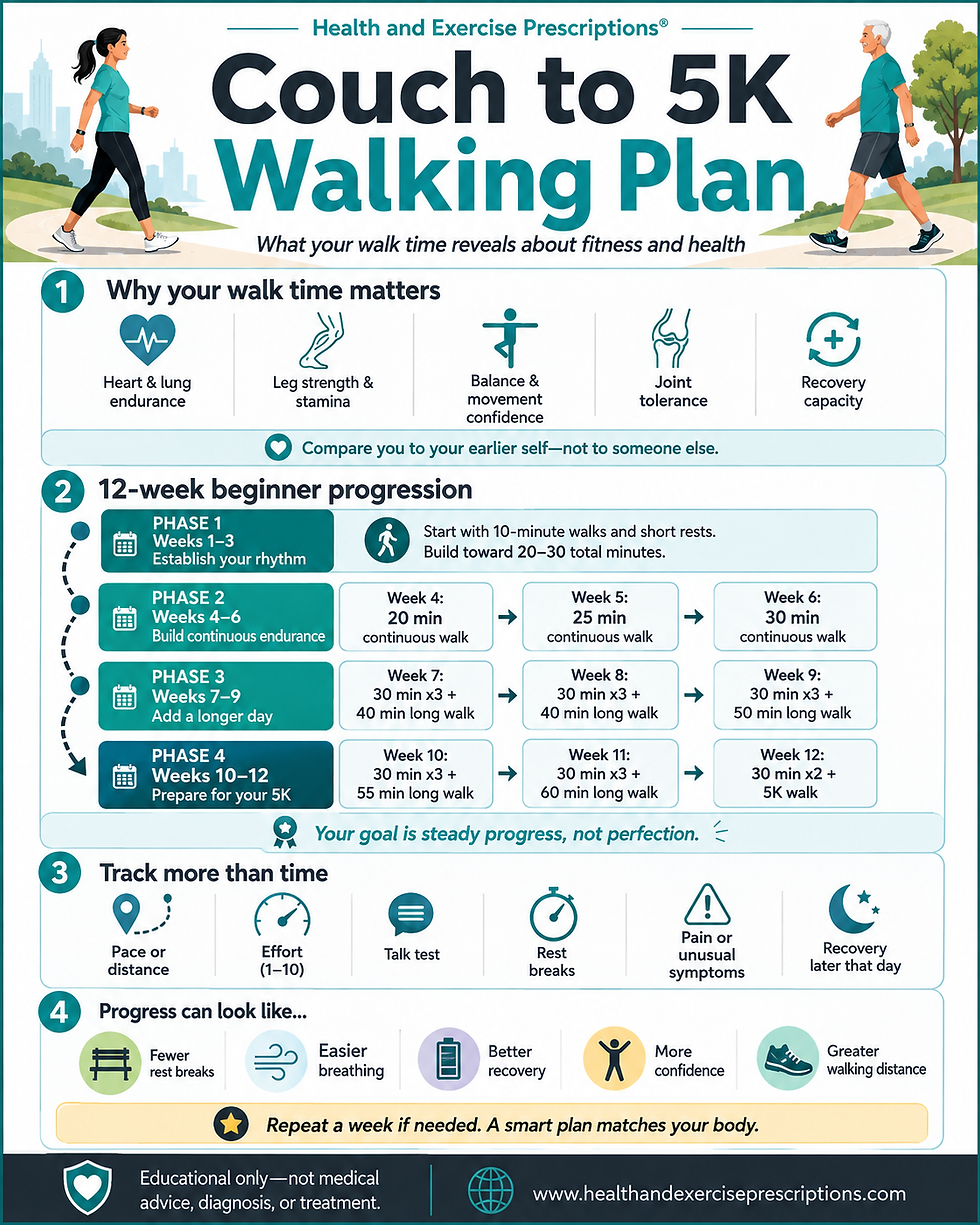
Couch to 5K Walking Plan: What Your Walk and Run Times Reveal About Fitness and Health
Most people think of walking time as a simple number: How fast did I finish the mile? How long did the trail take? Did I beat last week’s time?
But your walking or running time can tell a much larger story.
It may reflect how efficiently your heart and lungs are working, how much endurance your legs have developed, how confidently you move, how well you tolerate repeated impact, and how quickly you recover after exercise.
A stopwatch cannot diagnose your health, and a slower pace does not mean you are failing. However, when you track the same route under similar conditions, your time can become a practical measure of change.
That is what makes a gradual Couch-to-5K walking plan so useful. The goal is not merely to finish 3.1 miles. The goal is to build enough capacity that walking farther begins to feel safer, steadier, and more manageable.
Walking Speed Is More Than a Fitness Number
Walking requires several systems to cooperate at the same time.
Your heart and lungs must deliver oxygen. Your muscles must create enough force to move you forward. Your joints must tolerate repeated loading. Your nervous system must coordinate balance, rhythm, posture, and direction.
Because walking involves so many systems, gait speed is sometimes described as a functional vital sign. Research supports walking speed as a useful measure for monitoring functional status and general health, particularly among older adults. It has also been associated with disability risk, health outcomes, and survival. These are population-level associations—not a diagnosis based on one person’s pace.
The most useful comparison is usually not you versus another walker.
It is you versus your earlier self under similar conditions.
Suppose your familiar one-mile route initially takes 25 minutes and requires two rest breaks. Six weeks later, you complete it in 23 minutes without stopping and your breathing settles sooner.
You did not merely improve by two minutes. You may have developed better aerobic endurance, greater leg stamina, more movement confidence, and improved recovery.
Those are meaningful fitness changes.
What Your Walk or Run Time Can—and Cannot—Tell You
A faster time can indicate improving cardiovascular fitness, but time should never be interpreted alone.
Weather, hills, walking surface, pain, sleep, stress, hydration, medications, illness, and fatigue can all affect your performance on a particular day. A flat sidewalk mile cannot be directly compared with a hilly trail, and a rested morning walk cannot always be compared with an evening walk after a demanding day.
Your pace also does not need to improve every week. Fitness development is rarely a straight line.
Instead of tracking only your completion time, record:
Distance completed
Total time
Number of rest breaks
Effort on a scale of 1–10
Whether you could speak in complete sentences
Heart rate, when appropriate
Pain or unusual symptoms
Recovery during the next several hours
How you feel the following day
You may discover that your time remains the same while the walk becomes more comfortable. Perhaps you need fewer breaks, feel steadier on uneven ground, or recover quickly enough to continue with your day.
That is progress, too.
A Simple Baseline Before You Begin
Before starting the 12-week program, choose one safe measurement that you can repeat.
You might record:
Your comfortable one-mile walking time
The distance covered during a comfortable six-minute walk
The time required to complete a familiar neighborhood route
How many minutes you can walk before needing a break
How quickly your breathing returns toward normal afterward
The six-minute walk is widely used in clinical and research settings as a measure of functional exercise capacity. Research also suggests that, when performed under standardized conditions, it can provide useful information about aerobic fitness.
The one-mile walk test is another established submaximal assessment that can be used to estimate aerobic capacity when time, heart rate, age, and other factors are included. A formal test should be administered appropriately, especially for people with cardiovascular conditions, balance concerns, significant pain, or recent rehabilitation.
For this beginner program, you do not need to race.
Walk at a purposeful but sustainable pace, record what happens, and repeat the same measurement around weeks six and twelve.
Your Safe 12-Week Couch-to-5K Walking Plan
This progression is adapted from the Mississippi State Department of Health’s 12-week “Sofa to a 5K” walking plan. It begins with short walking intervals, progresses to 30-minute continuous walks, and gradually introduces one longer weekly session.
Weeks 1–3: Establish Your Walking Rhythm
Week 1 — Three days
Walk for 10 minutes, rest for 3 minutes, walk for 5 minutes, rest for 1 minute, and repeat the 5-minute walk.
Week 2 — Three days
Walk for 10 minutes, rest for 1 minute, walk for 5 minutes, rest for 1 minute, and repeat the 5-minute walk.
Week 3 — Three days
Walk for 10 minutes, rest for 1 minute, walk for another 10 minutes, rest for 1 minute, and repeat the 10-minute walk when comfortable.
Your first objective is consistency—not speed. Finish feeling as though you could have done a little more.
Weeks 4–6: Develop Continuous Endurance
Week 4 — Three days
Walk continuously for 20 minutes.
Week 5 — Three days
Walk continuously for 25 minutes.
Week 6 — Three days
Walk continuously for 30 minutes.
By week six, repeat your original baseline under similar conditions. Look beyond the clock. Are you walking with fewer breaks? Is your posture more relaxed? Does your breathing recover sooner?
Weeks 7–9: Add a Longer Walking Day
Week 7 — Four days
Walk for 30 minutes on three days. Complete one 40-minute walk.
Week 8 — Four days
Walk for 30 minutes on three days. Complete one 40-minute walk.
Week 9 — Four days
Walk for 30 minutes on three days. Complete one 50-minute walk.
The longer session is designed to improve endurance, not test your limits. Keep the pace conversational and choose a predictable route.
Weeks 10–12: Prepare for Your 5K
Week 10 — Four days
Walk for 30 minutes on three days. Complete one 55-minute walk.
Week 11 — Four days
Walk for 30 minutes on three days. Complete one 60-minute walk.
Week 12 — Three days
Walk for 30 minutes on two nonconsecutive days. Later in the week, complete your 5K walk.
Your 5K does not need to be an organized race. It can be a measured neighborhood route, track, park path, or local event.
The objective is to complete the distance comfortably and safely.
Should You Repeat a Week?
Absolutely.
Repeating a week is not failure. It is often a smart exercise prescription.
Repeat the week when you experience persistent joint discomfort, excessive fatigue, worsening balance, unusual soreness, disrupted sleep, or a level of effort that remains too high.
You can also reduce the duration. A person returning after rehabilitation might need to begin with five-minute walks rather than ten-minute walks. An older adult may need a level surface, a walking partner, or an assistive device recommended by a qualified professional.
The schedule should fit your current capacity. Your body does not need to fit the schedule.
When Walking Can Safely Become Walk-to-Run Training
Some people will want to add light jogging after completing the walking plan. That transition should depend on more than enthusiasm.
Before adding running intervals, you should generally be able to walk for approximately 30–45 minutes with controlled breathing, stable movement, manageable joint response, and reasonable recovery afterward.
Begin with brief jogging intervals rather than suddenly attempting a continuous run. Your cardiovascular system may adapt faster than your feet, calves, knees, hips, and connective tissues. Gradual loading gives those tissues time to become more tolerant.
Running times can then be tracked in the same way as walking times. Completing the same route slightly faster at the same effort—or maintaining the same pace with easier breathing and better recovery—may indicate improving fitness.
Do not turn every workout into a race against the clock.
Your easy days should still feel easy.
The Bigger Goal Is Functional Capacity
Cardiorespiratory fitness is strongly associated with cardiovascular health, chronic-disease risk, and longevity. Large scientific reviews consistently find that greater cardiorespiratory fitness is associated with lower risks of cardiovascular disease and premature mortality.
That does not mean everyone needs to become a runner.
For one person, improved fitness means hiking again. For someone recovering after rehabilitation, it means walking without fear. For an older adult, it may mean shopping independently, carrying groceries, traveling, climbing stairs, or keeping up with grandchildren.
The federal Physical Activity Guidelines recommend 150–300 minutes of moderate aerobic activity each week for most adults, along with muscle-strengthening activities on at least two days. Older adults are also encouraged to include balance training and adjust effort relative to their fitness and medical conditions.
Walking can help build that foundation, but a complete health prescription may also include strength, balance, mobility, recovery, nutrition, and individualized progression.
The HEP® Walking Prescription
Start where you are.
Track enough information to recognize meaningful change, but do not allow the clock to become a judgment. A faster pace can be encouraging, but increased comfort, fewer rest breaks, improved balance, and greater confidence may matter even more.
Your goal is not simply to complete a 5K.
Your goal is to build a body that can participate more fully in your life.
Build a Plan for Your Body
Health and Exercise Prescriptions® provides personalized medical exercise, post-rehabilitation training, cardiovascular programming, strength development, mobility work, balance training, therapeutic bodywork, and holistic wellness support in Bellingham, Washington.
A personalized assessment can help determine your appropriate starting point, walking intensity, impact tolerance, recovery needs, and readiness to progress toward jogging or running.
Health and Exercise Prescriptions®https://www.healthandexerciseprescriptions.com/
Curated Thorne Supplement Storehttps://www.thorne.com/u/HealthAndExercisePrescriptions
Bellingham Location and Reviewshttps://share.google/qlocjGNot6ruz2Kd2
Related Health and Exercise Prescriptions® Articles
“Do not use your pace to judge your body. Use it to understand how your body is adapting.” — Jaime Hernandez
Author Bio
Jaime Hernandez is a certified health and wellness professional with 25 years of expertise in medical exercise, personal training, therapeutic bodywork, massage, and holistic fitness. He is the founder and Executive Coach of Health and Exercise Prescriptions® in Bellingham, WA, where he develops personalized health and wellness plans designed to help individuals improve strength, mobility, and overall well-being across all stages of life.
Jaime holds certifications as a Medical Exercise Specialist, Licensed Massage Therapist #MA60804408, and trainer in Yoga, Pilates, and Craniosacral Therapy, combining multiple modalities to support post-rehabilitation recovery, preventive health, and functional movement optimization. His approach blends science-based exercise prescription with therapeutic practice to help clients prevent disease, manage chronic conditions, and achieve their health goals.
Health and Exercise Prescriptions®
Thank you for your time and energy...Be well.
Medical Disclaimer
This content is for educational purposes only and does not constitute medical or rehabilitation advice, diagnosis, or treatment. Consult your physician or qualified healthcare provider before starting or changing an exercise program—especially if you have pain, injuries, cardiovascular, metabolic, neurological, balance, or other medical conditions.
Stop any activity that causes sharp pain, dizziness, chest discomfort, faintness, unusual shortness of breath, or symptoms that feel unsafe, and seek appropriate medical care.


Comments