


VO₂ Max Training From Beginner to Advanced: A Safer Exercise Prescription

VO₂ Max Training From Beginner to Advanced: A Safer Exercise Prescription
How Heart-Rate Response, Impact Load, and Recovery Shape Your Training Plan
VO₂ max training is usually marketed to runners who want to become faster. You may see intimidating workouts filled with sprints, race paces, heart-rate zones, and intervals that appear designed only for experienced athletes.
But cardiovascular capacity matters to far more than runners.
For one person, improving VO₂ max may mean finishing a faster 5K. For another, it may mean climbing stairs without stopping, hiking with family, returning to activity after rehabilitation, carrying groceries, or maintaining enough physical reserve to remain independent.
At Health and Exercise Prescriptions®, I look at VO₂ max as part of your aerobic reserve: the amount of cardiovascular capacity available beyond what you need for normal daily activity.
The objective is not to make everyone train like an athlete. The objective is to apply the right cardiovascular challenge for your current health, conditioning, movement ability, and recovery capacity.
The best cardiovascular program is not the hardest workout you can survive. It is the right dose of stress that your body can recover from, adapt to, and safely repeat.
What Is VO₂ Max?
VO₂ max describes the maximum amount of oxygen your body can take in, transport, and use during demanding exercise.
It reflects the combined work of your:
Heart
Lungs
Blood vessels
Circulation
Working muscles
Cellular energy systems
A laboratory test provides the most direct measurement, but many people rely on estimates from fitness testing, heart-rate data, walking or running performance, and wearable devices.
The number itself is useful, but the larger issue is what that capacity allows you to do.
A strong cardiovascular system gives you more room between normal daily activity and your physical limit. That reserve can make walking, climbing, hiking, traveling, working, and recreational activity feel more manageable.
Large research reviews have found that higher cardiorespiratory fitness is strongly and consistently associated with better health outcomes and lower risk of premature death. (PubMed)
The HEP® Difference: We Do Not Prescribe From One Number
A generic online plan may assign a pace, heart-rate percentage, or number of intervals based only on age or running experience.
That is not enough for a personalized exercise prescription.
At Health and Exercise Prescriptions®, I consider three major forms of readiness:
Cardiovascular readiness
Can your heart, lungs, and circulation tolerate the planned intensity?
Mechanical readiness
Can your feet, ankles, knees, hips, spine, muscles, tendons, and connective tissues tolerate the impact and repetition?
Recovery readiness
Can you recover without prolonged fatigue, increased pain, worsening movement, disrupted sleep, or declining performance?
These areas do not always progress at the same speed.
Your cardiovascular system may be ready for a harder challenge while your knees, Achilles tendons, hips, or lower back are not ready for additional running impact.
That does not mean cardiovascular progress has to stop. It means we select a different tool.
How I Use Estimated Maximum Heart Rate
Heart rate is one piece of the assessment—not the entire prescription.
In my practice, I use a working estimate of maximum heart rate that considers factors such as age and body-size appropriateness. I do not treat that estimate as an exact physiological limit, and I do not rely on a single generic formula for every client.
The specific calculation is part of the tailored HEP® design process rather than a public, one-size-fits-all recommendation.
Once I have a starting estimate, I compare it with:
Resting heart rate
Current conditioning
Exercise history
Medications
Breathing response
Rate of perceived exertion
Talk-test response
Movement quality
Recovery between intervals
Symptoms during and after exercise
Heart-rate recovery after the effort ends
This matters because estimated maximum heart rate can differ from a person’s true maximum. Medications such as beta blockers can also reduce the normal heart-rate response to exercise, making standard percentage-based targets less dependable. Clinical exercise-prescription guidance therefore supports combining heart-rate information with perceived exertion, symptoms, and other observations. (PubMed)
A smartwatch can help us observe patterns, but it is not a diagnosis and it does not replace an appropriate medical evaluation when cardiovascular symptoms or health concerns are present.
Heart rate gives us information. It does not make the entire decision.
Impact Load Must Also Match the Person
Two exercises can create a similar cardiovascular challenge while placing very different loads on the body.
Running includes repeated landing forces. Depending on speed, technique, surface, strength, tissue tolerance, and training history, those forces may be appropriate—or they may be too much at the present time.
Incline walking can substantially raise cardiovascular demand without requiring the same running impact. Research comparing vigorous incline walking with running at a similar aerobic intensity found that running produced greater impact forces. Other research has found that slower uphill walking can reduce loading rates and certain lower-extremity joint moments compared with faster level walking. (PubMed)
This gives us options.
A person may train the cardiovascular system through:
Incline treadmill walking
Outdoor hill walking
Stationary cycling
Recumbent cycling
Elliptical training
Pool walking
Swimming
Rowing when appropriate
Stair climbing
Walk-run intervals
Continuous running
Structured running intervals
The mode should match the person—not the trend.
Before adding higher-impact training, I consider previous injuries, surgeries, arthritis, joint replacements, balance, bone health, lower-body strength, movement mechanics, footwear, training surface, pain response, and next-day recovery.
Lower impact does not automatically mean an easy workout. Incline, resistance, cadence, interval duration, and recovery can all be adjusted to produce a meaningful cardiovascular stimulus.
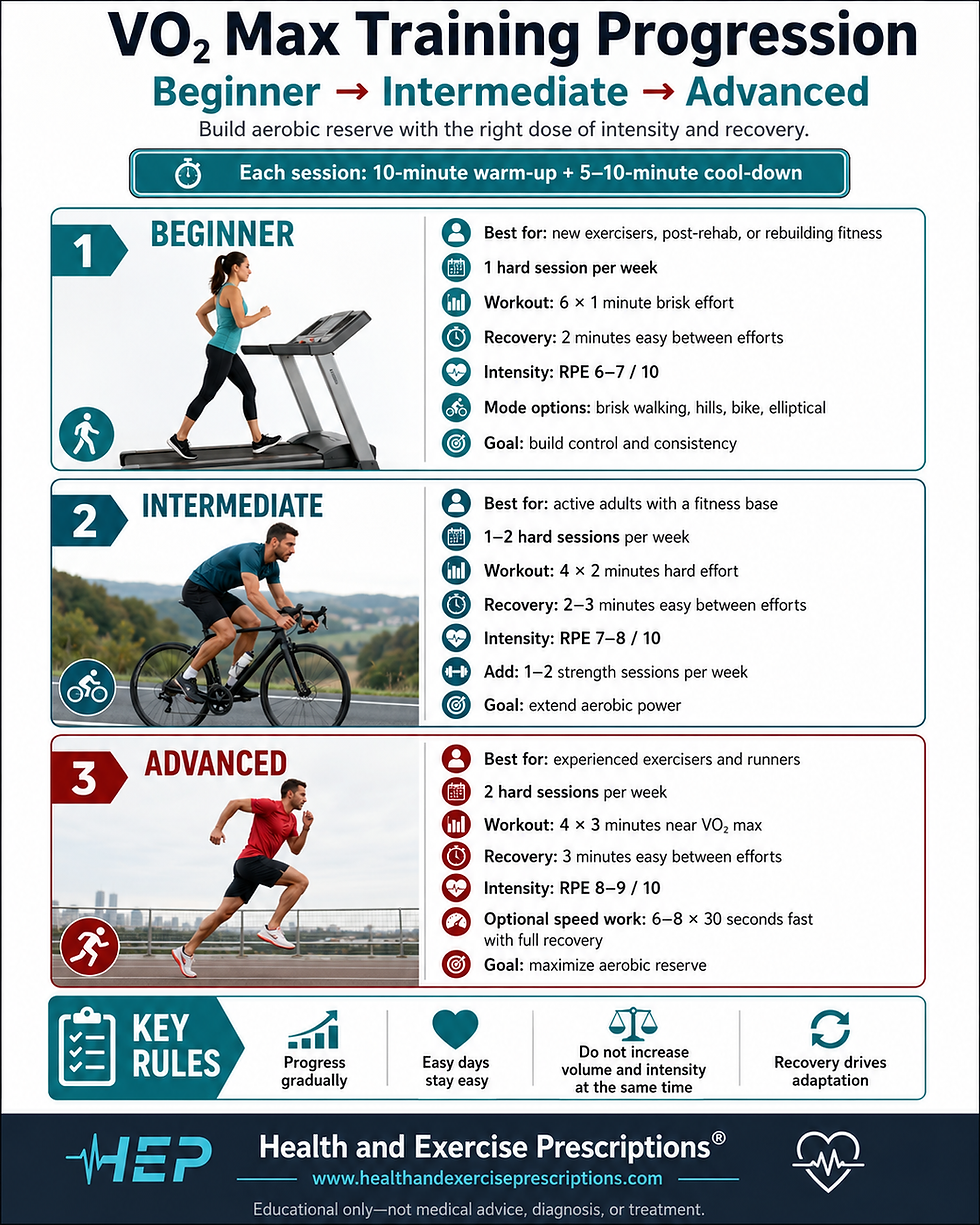
The Beginner VO₂ Max Progression
Best for:
New exercisers
Post-rehabilitation clients who are cleared for activity
People returning after illness or inactivity
Older adults rebuilding cardiovascular reserve
Anyone unfamiliar with interval training
Begin with approximately 10 minutes of gradual movement.
The main workout may include:
Six controlled rounds
One minute of brisk effort
Two minutes of easy movement
Finish with five to ten minutes of gradually decreasing activity.
The brisk portion should feel purposeful but controlled. Breathing should increase, but the person should not be sprinting, straining, or losing movement quality.
Depending on impact appropriateness, the session may use brisk walking, an incline treadmill, a stationary bicycle, an elliptical, or another suitable low-impact mode.
Most beginners should start with one structured interval session per week while building an aerobic foundation through easier activity on other days.
The goal is not to reach a dramatic heart-rate number.
The goal is to create a predictable pattern:
Increase effort → maintain control → recover → repeat
The Intermediate VO₂ Max Progression
Best for:
Active adults with an established fitness base
Recreational walkers, hikers, cyclists, or runners
Clients who recover well from beginner intervals
People ready for longer controlled efforts
Begin with a gradual warm-up.
The main workout may include:
Four controlled rounds
Two minutes of challenging effort
Two to three minutes of easy recovery
The harder interval should make extended conversation difficult, but movement should remain stable and technically sound.
Depending on the client, this may involve faster hill walking, cycling against resistance, elliptical intervals, rowing, stair work, or controlled running.
One or two harder cardiovascular sessions per week may be appropriate, provided they are separated by easier training or recovery days.
Strength training also becomes increasingly important. Stronger legs, hips, calves, trunk muscles, and connective tissues can improve efficiency and prepare the body for greater speed, incline, resistance, or impact.
The Advanced VO₂ Max Progression
Best for:
Experienced runners or cyclists
Well-conditioned recreational athletes
People accustomed to structured interval training
Clients with stable movement, strength, and recovery
A more advanced session may include:
Four rounds
Three minutes of hard, controlled effort
Three minutes of active recovery
Advanced exercisers may also use shorter speed intervals during a separate session, but sprinting and longer VO₂ max intervals do not provide exactly the same training stimulus.
The six-week Runner’s World program that inspired this discussion is designed primarily for intermediate-to-advanced recreational runners with a consistent endurance base and previous speed-work experience. It combines structured intervals with easier running, strength training, recovery, and a lighter period after the training block. (Runner's World)
That can be appropriate for a trained runner.
It is not automatically appropriate for someone returning from surgery, managing chronic pain, taking heart-rate-altering medication, or beginning exercise after a long sedentary period.
Research supports both continuous aerobic training and higher-intensity interval training for improving VO₂ max. Higher-intensity training can sometimes produce greater improvements, but the response depends on baseline fitness, program design, intensity, duration, and the individual performing it. (PubMed)
Advanced does not mean careless.
It means the person has built the physical foundation required to use a larger training dose appropriately.
How We Decide When to Progress
A calendar does not decide when someone is ready.
Before progressing, I look for evidence that the current workload is being tolerated.
Positive signs include:
Stable movement from the first interval through the last
Predictable heart-rate response
Appropriate breathing recovery
No concerning symptoms
No meaningful increase in joint or tendon pain
Normal walking mechanics after the session
Energy returning by the following day
Consistent performance over several workouts
Good sleep and overall recovery
Progression may involve changing one variable at a time:
Interval length
Number of intervals
Speed
Resistance
Incline
Weekly frequency
Running duration
Mechanical impact
We do not need to increase all of these simultaneously.
For example, a client may first increase treadmill incline while continuing to walk. Later, we may add a small amount of jogging while keeping the total workout time stable. Only after that load is tolerated would we consider increasing running duration or speed.
Your heart may be ready for more work before your joints are ready for more impact. We can challenge one without unnecessarily overloading the other.
My Long-COVID Cardiovascular Recovery
My own long-COVID experience reinforced the importance of patient, measurable cardiovascular progression.
After COVID-19 affected my cardiovascular capacity, my mile pace changed significantly. Work that had once felt familiar required much more effort.
Instead of trying to force my old performance, I used a heart-rate monitor and repeated the same routes. Keeping the route consistent helped reduce variables so I could better compare pace, heart-rate response, terrain, and recovery.
It took approximately nine months before I could gradually reintroduce stairs, hills, and short hill sprints. My fuller cardiovascular recovery took approximately a year and a half.
That experience confirmed something I have seen repeatedly during 25 years of working with clients:
You cannot bully the body into adapting faster.
You can provide a clear stimulus. You can monitor the response. You can support recovery. Then you can gradually increase the prescription when the body demonstrates readiness.
Recovery Drives the Adaptation
Training creates the signal for change. Recovery is where the body responds to that signal.
A complete cardiovascular prescription should include:
Easy aerobic days
Adequate sleep
Hydration
Appropriate nutrition
Strength training
Mobility work
Nervous-system recovery
Lighter training periods
Regular reassessment
Warning signs that the dose may be too high include persistent fatigue, declining performance, elevated pain, disrupted sleep, irritability, unusual shortness of breath, heavy legs, or feeling depleted before each workout.
Harder training is not automatically better training.
The best program produces progress without repeatedly breaking down the person performing it.
Build Your Cardiovascular Prescription Around Your Life
VO₂ max training should help you do more in the life you actually live.
That might mean:
Walking through Boulevard Park without needing frequent stops
Hiking in the Chuckanuts
Keeping up with your grandchildren
Returning to recreational running
Carrying groceries independently
Playing golf or pickleball
Traveling with greater confidence
Recovering from daily demands more easily
Staying in your own home as you age
Beginner, intermediate, and advanced are not judgments of your value or ability.
They are starting points.
The correct level is the one that matches your cardiovascular capacity, impact tolerance, health history, and ability to recover today.
Related Health and Exercise Prescriptions® Articles
Start with a gradual walk-to-run progression designed for beginners and people returning to cardiovascular exercise. (Health & Exercise Rx)
Progress from walking to running with structured intervals, strength, recovery, and local Bellingham inspiration. (Health & Exercise Rx)
Learn why sleep, nutrition, strength, and planned recovery are essential parts of adaptation. (Health & Exercise Rx)
Ready for a Tailored Health and Exercise Prescription?
You do not have to guess which heart-rate range, exercise mode, interval length, or impact level is right for you.
At Health and Exercise Prescriptions®, I design programs around your health history, current capacity, previous injuries, movement quality, cardiovascular response, recovery, and personal goals.
Author Bio
Jaime Hernandez is a certified health and wellness professional with 25 years of expertise in medical exercise, personal training, therapeutic bodywork, massage, and holistic fitness. He is the founder and Executive Coach of Health and Exercise Prescriptions® in Bellingham, WA, where he develops personalized health and wellness plans designed to help individuals improve strength, mobility, and overall well-being across all stages of life.
Jaime holds certifications as a Medical Exercise Specialist, Licensed Massage Therapist # MA60804408, and trainer in Yoga, Pilates, and Craniosacral Therapy, combining multiple modalities to support post-rehabilitation recovery, preventive health, and functional movement optimization. His approach blends science-based exercise prescription with therapeutic practice to help clients prevent disease, manage chronic conditions, and achieve their health goals.
Health and Exercise Prescriptions®
Thank you for your time and energy...Be well.
#VO2Max#CardiovascularFitness#ExercisePrescription#MedicalExercise#IntervalTraining#HeartRateTraining#LowImpactExercise#PostRehabilitation#HealthyAging#FunctionalFitness#RunningHealth#BellinghamFitness#BellinghamWellness#HealthAndExercisePrescriptions
References
Crowley E, et al. Exercise training intensity and VO₂ max in healthy adults: an overview of systematic reviews and meta-analyses. (PubMed)
Lang JJ, et al. Cardiorespiratory fitness as a predictor of health outcomes in adults: overview of meta-analyses. (PubMed)
Milanović Z, et al. Effectiveness of endurance training and high-intensity interval training for improving VO₂ max. (PubMed)
Swain DP, et al. Impact forces of walking and running at the same aerobic intensity. (PubMed)
Ehlen KA, et al. Energetics and biomechanics of inclined treadmill walking in older adults. (PubMed)
American Society for Preventive Cardiology. Physical activity, cardiorespiratory fitness, exercise intensity, and prescriptive methods. (PubMed)
Runner’s World. Six-week VO₂ max training plan for intermediate-to-advanced runners. (Runner's World)
Legal Disclaimer
This content is for educational purposes only and does not constitute medical or rehabilitation advice. Consult your physician or qualified healthcare provider before starting or changing an exercise program—especially if you have pain, injuries, cardiovascular, metabolic, or other medical conditions.
Stop any activity that causes sharp pain, dizziness, faintness, chest discomfort, an irregular heartbeat, unusual shortness of breath, or other concerning symptoms. Seek appropriate medical evaluation when symptoms are new, severe, persistent, or unexplained.
This information is not intended to be a substitute for professional medical advice, diagnosis, or treatment. Heart-rate calculations, wearable-device readings, and fitness estimates are screening and training tools rather than medical diagnoses.
Supplement products are not intended to diagnose, treat, cure, or prevent disease. Discuss supplement use with a physician or qualified healthcare professional, particularly when taking medications, preparing for surgery, pregnant or nursing, or managing a medical condition.


Comments